














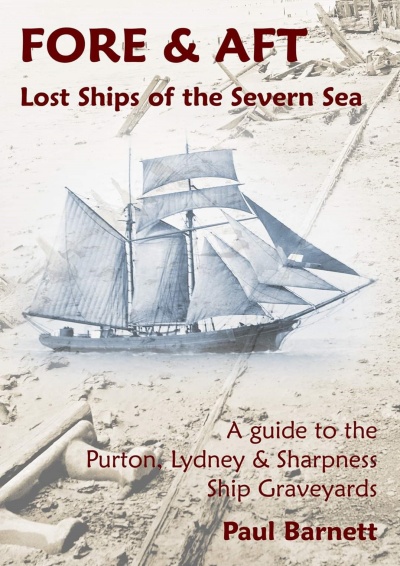
Paul Barnett is pleased to announce that he has now completed and had published his life’s work.
Entitled "Fore and Aft - Lost Ships of the Severn Sea", this 192 page guidebook details final resting places of the 121 vessels at Purton, Lydney and Sharpness.
It includes over 450 unique photos.
Signed copies can be obtained for £14.95 plus £2.50 p&p via cheque to Paul's address: 19 Lea Road, Brockworth, Gloucester, GL3 4JD, or via Bacs or PayPal to barnadillo@aol.com.
Lydney's Lost Fleet - The Lydney Ships Graveyard
Winner of the Nautical Archaeological Societies coveted award: Adopt A Wreck 2007 & The Forest of Dean Local History Societies: Scott-Garrett Award 2008
The second in the trilogy of talks regarding the long since abandoned and forgotten hulks of the mighty River Severn. Entitled Lydney's Lost Fleet, The Lydney Ships Graveyard, this unique 45 minute-1 hour slide presentation seeks to transport the viewer from the hustle and bustle of a 1930s working dock, engaged in the transhipment of Forest steam coal, thought to its eventual decline in the 1960s and recent rebirth as a sailing Mecca and tourism attraction of the Severn Estuary.
To this end and upon visiting the nearby adjacent foreshore, many visitors would be forgiven for not noticing that the rugged wave swept bank which falls away before them, is the last known resting place of some twenty one trows and river going barges.
Sadly like the dock, the foreshore is now devoid of this once proud fleet, abandoned like so many others to strengthen the constantly shifting coastline. Furthermore the sea continues to reclaim its own and in light of the last eighty years of surging tides, the bank has once more been swept clean by nature and mankind in his constant thirst for salvage.
Very little now remains, the odd stick of timber here and the twisted iron knee there. However with the use of a recently rediscovered archive and images dating back to the early 1930s, Paul Barnett is able to recreate a comprehensive timeline which seeks to illustrate individual working craft, their early abandonment and current remains following decades of destruction.
As with Fore & Aft, The Purton Ships Graveyard, Paul attempts to relay a sense of the Severn's maritime past though anecdotal memories, light hearted nautical banter and welcome audience participation throughout. Further Lydney's Lost Fleet attempts to complete the chapter on this once thriving maritime community whilst in part seeks to act as fitting epitaph to this lesser known ships graveyard in the Severn Sea.
Sharpness' Scuppered Ships - The Sharpness Ships Graveyard
Winner of the Nautical Archaeological Societies coveted award: Adopt A Wreck 2007 & The Forest of Dean Local History Societies: Scott-Garrett Award 2008
Billed as the eagerly awaited last instalment of the hulks trilogy and hue of rock and iron, you are cordially invited to accompany local maritime historian Paul Barnett on a pictorial journey through the scattered maritime remains which litter the regions windswept foreshore, adjacent to the turbulent waters of the mighty River Severn.
This 45 minute-1 hour slide presentation effectively secures closure on long lost maritime memories of this industrious region by the author's skilful and now familiar format of using rare and historic images to catalogue the history of the thirty eight vessels, which make up this fascinating collection. Stretching from the foot of round house of old Severn & Wye Railway Bridge, the viewer is taken of on a riverside pictorial journey southwards, skirting the Sharpness to Gloucester Old Arm only to arrive safely at the foot of the Sharpness Entrance North Pier.
Originally beached in 1968 at the behest of former canal Superintendent Donald Fowler to prevent scour and the continued formation of the "Gutter" The Sharpness Ship Graveyard is now known to be the last resting place of the Appledore built "Village Fleet" including amongst others the Cam, Tuffley, Barnwood and Cranham.
Positioned forward and almost totally obscured by vegetation and years of deposition, lie the affectionately named Bird Class Barges the Severn Falcon, Severn Hawk and Severn Eagle who as you will see are deemed to fly no more and yet remain of great industrial importance.
Further afield, the Sharpness foreshore once hummed to the hammers of destruction as famous vessels such as the Bridgwater Schooner C & F Nurse, the mighty crane elevator Cardiff and the Aust ferry Severn King all gave up their strength as they were broken and carted from the waters of the river for salvage.
As with Fore & Aft, and Lydneys Lost Fleet, the viewer is assured of an informative look at the Severn's maritime past though anecdotal memories, light hearted nautical banter and welcome audience participation throughout. Further Sharpness's Scuppered Ships attempts to highlight a forgotten chapter of this hugely successful country dock and its resilient maritime community
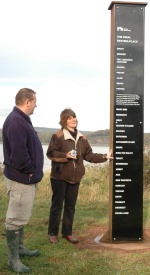
The Friends of Purton are overjoyed at the news that after 12 years of delicate negotiations, the Purton Hulks have been formally adopted by British Waterways who recently announced that they have taken the proactive step of registering ownership of the land encompassing the hulks.
In a statement Mr Brian Casey of British Waterways formally acknowledged that "This land has been registered and is in British Waterway ownership". Mr Casey went on to advise "We have checked our records on this and cross referenced these with the Land Registry and can confirm that British Waterways own the land on which the Hulks sit".
Upon hearing the news Friends of Purton Chairman Paul Barnett was said to be elated "This is a great day for these last remnants of our maritime history" he commented. " For too many years we have witnessed our heritage be habitually destroyed by vandalism and arson. Now at last British Waterways, by taking this monumental decision, have embraced the challenge to ensure that these few remaining relics are given a fighting chance. We therefore applaud BW and welcome the chance to strengthen existing ties with the land owner for the benefit of the regions heritage and tourism".
The news comes in the wake of an earlier announcement that the site's last remaining Kennet built canal boat Harriett has been afforded legal protection as a Scheduled Ancient Monument. Initial indications are that as the ownership of the site has now been recorded with English Heritage, Natural England and the County Archaeologist, there is little now to prevent the site being registered as an assemblage worthy of further designation and protection.
For further details or to add your support please see www.friendsofpurton.org.uk
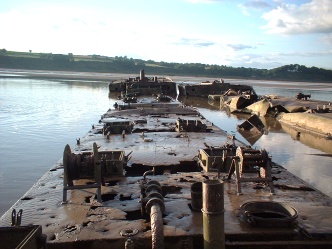
When one considers the nation's long and rich maritime heritage, one does not ordinarily consider the windswept shores of the upper reaches of the River Severn.
Neither, might I add, does one ordinarily associate the sleepy Gloucestershire hamlet of Purton as a last bastion of this once proud maritime way of life.
However, look closer, as first impressions can often be deceptive.
None more so than the adjacent foreshore and beyond the rolling hills and gently grazing cattle, as here lies the last resting place of bones of the nation's largest collection of nautical wrecks.
This however, was never always the case and as we will see it has taken some 10 years of in-depth research and only now is the mighty Severn giving up her secrets and unearthing the wonder that is the Purton Hulks.
Paul Barnett, born the third son of a merchantman within the shadow of the mighty shipbuilding gantries of Swan Hunter, Newcastle upon Tyne, and therefore a stranger to these southern shores, has subsequently dedicated his life to researching and comprehensively recording and documenting this national treasure.
He picks up the story "I originally discovered the site in 1976 further to my family's relocation due to work commitments. At that time as a boy the site left me spellbound and with so many questions unanswered - the whys, the whens and the what fors".
"In 1998 upon returning to the UK following a life at sea employed as a Hydrographic Surveyor, I once again became intrigued with the site and embarked on a programme of research in the hope that one day this site would eventually give up its secrets. Little did I know what lay ahead"
"My initial efforts were to identify what I believed were the remains of 23 former vessels/piles of decomposing timbers to the north of the study area. However it is now my firm belief that the site, which stretches from the waste weir in the north to the Sharpness New Dock entrance in the south, is the final resting place of 81 vessels which encapsulate steel, timber and concrete constructions."
This understanding has only been made possible following a epic journey that has taken him to Garmouth in the far north of Scotland, to the Devon seaport of Appledore, to the eastern boards of Lowestoft through the mountainous backdrop of Porth Madoc beyond to the emerald isles and rugged Irish coastline of Waterford. He now feels he has at least a mega grasp on the site's hidden treasures.
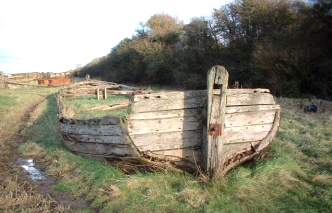
The story begins around 100 years ago on 23 December 1909 after A J Cullis, then Chief Engineer of the Berkeley, Gloucester and Birmingham Canal, was hurriedly summoned to the outskirts of the village.
His task was to assess the massive landslip that had earlier removed 60 metres of the nearby riverbank and hedge, leaving the adjacent canal and a main artery to the Midlands exposed and in danger of destruction.
As a temporary solution he rapidly assembled a small fleet of five timber work barges which were then immediately taken into the river and ran up onto the foreshore in an attempt to shore up the eroding river bank.
It worked, and as a result of this epic rescue operation the canal and its vital link was saved.
That said, it has been necessary as a result of the ongoing march of coastal erosion or the desire to rid owners of the burgeoning cost of maintaining timber vessels, the site has continued to develop whilst allowing the last remaining ounces of a ship's soul to be preserved in silt, sand and Severn mud.
Paul continues: "After decades of tidal ebb and flow, I returned to the site in 1998 and was horrified to be met with a sight of total devastation and mindless destruction: the site had been ravaged by man and several vessels had been razed to the ground by fire.
"However, not before their images and locations were captured for posterity by an array of eminent maritime historians and interested players.
"To this end I am immensely privileged to have met, been tutored by and formed a lasting friendship with the eminent architect and maritime author David R MacGregor, who had previously studied the site during the early 1950s in the wake of his good friends and mentors, Bristol based Maritime Historian Graham Farr and a former curator of the Maritime Museum, Greenwich, Basil Greenhill.
"Sadly David died in November of 2003, but not before he had guided me thought the complex world of vessel construction, sail rig, registration and insurance classification. For this I will always be indebted for his kindness, continued encouragement and insistence that I pose questions regarding this ever expanding and unique collection of vessels.
To date I have in excess of 300 photographs, which chronicle the life and death of each vessel.
These are catalogued to represent the individual vessels afloat/in use, during earlier stages, post abandonment and pre decomposition/vandalism/arson/trophy hunters and finally as they look today.
With the use of several sources and modern surveying techniques, I have produced a schematic diagram, which locates each vessel by scale and heading.
I intend to document the site and its artefacts in the hope that a befitting testimony is created, recorded and deposited at the Gloucestershire office of the Sites and Monuments Record.
This is considered vital in order to document these once fine vessels, their courageous crews, forward-thinking ships owners, skilled shipwrights/builders, and associated country folk, who depended so heavily on this now long since departed way of life.
In doing so I wish to acknowledge the many researchers and individuals who have tirelessly relayed their knowledge and personal accounts, without whom the history of the site would have remained buried within the silent banks of the mighty River Severn.
Please be advised that this work is ongoing, with a view to identifying the remaining vessels. I continue to request any information, photographs or contacts and would welcome the opportunity to discuss my findings in greater detail.
Please note that the utmost care will be taken to preserve and accurately reference any information submitted.
To this end I am very keen to hear from any persons or organisations that have access to geophysical instruments in order to conduct a non-invasive ground penetrating survey or sub aqua personal who would be willing to conduct an underwater survey of the 9 vessels, which are currently submerged in the high visibility and non tidal waters of the adjacent canal.
Furthermore for those wishing to attend the site, I am willing to conduct guided tours for individuals or parties of up to 20 persons and I particularly welcome requests from local history or archaeology groups."
For more information and dates please contact Paul Barnett directly by telephone 07833 143231, by post to 22 Gurney Avenue, Tuffley, Gloucester GL4 OYL or via email at
To find out more about vessels in the Purton Hulks fleet, please visit
www.friendsofpurton.org.uk
